First, what is a CMS?
A CMS (Content Management System) is a platform that allows you to create, manage, and publish content on a website without requiring advanced technical skills. Popular CMS platforms include WordPress, Drupal, Squarespace, and Wix. They provide a simple interface to add pages, update text or images, and manage site structure.
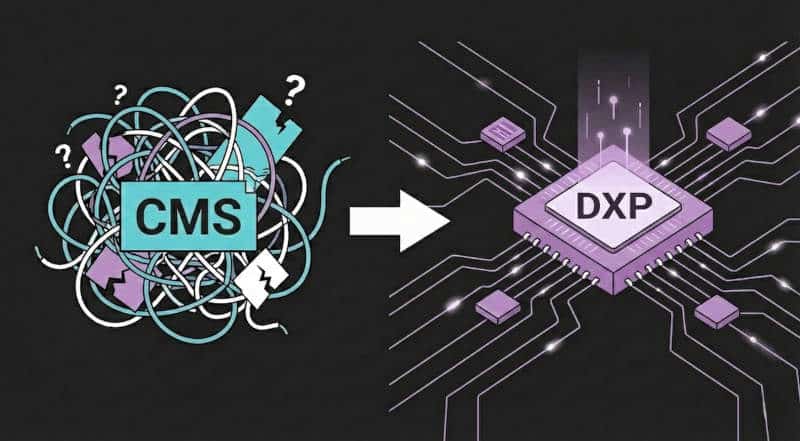
However, as organizational needs become more complex, these tools eventually reach their limits — and that’s exactly what we explore in this article.
When your CMS is no longer enough: The Signals it’s time to move to an enterprise DXP
WordPress, Wix, Squarespace, Drupal, Joomla…
These platforms power millions of websites worldwide. They are accessible, often affordable, and perfect for getting started.
But at some point, certain organizations inevitably outgrow them. At Sengo, we frequently guide companies through this delicate transition, and we’ve identified the key indicators that it may be time to consider a CMS/DXP platform built for enterprise scale, such as Kentico, Sitecore, Optimizely, Contentful, or Storyblok.
The hidden cost of complexity
The first signal often appears on your monthly invoices.
Maybe you started with WordPress and a few free plugins, or with a budget-friendly Wix plan that promised “everything you need.”
Today, you’re running 15, 20, or even 30 paid plugins to support advanced forms, security, performance, multilingual content, integrations with your CRM, ERP, or marketing platform.
Each plugin represents:
With platforms like Drupal, you might have more technical control, but the maintenance overhead becomes a burden. Builders like Wix or Squarespace offer simplicity, but you quickly hit a ceiling in terms of customization and integrations.
When the total cost of ownership of your current CMS begins approaching that of an enterprise platform — without offering the stability, security, or built-in capabilities of one — that’s a clear signal.
We regularly see organizations spending as much on plugins, maintenance, and technical workarounds as they would on an enterprise solution… without gaining the benefits.
At that stage, investing in platforms like Kentico or Optimizely often becomes the smarter long-term decision.
When Governance Becomes a Headache
You manage several websites:
Different languages, microsites for campaigns, portals for different audiences…
With most traditional CMS platforms, each site is its own separate instance.
Changing your brand guidelines means updating ten or fifteen different sites. Ensuring consistency becomes a challenge — especially when multiple teams are involved.
With Wix or Squarespace, sharing templates or components across sites is limited. With Drupal, it’s possible but complex.
Enterprise DXP platforms are built for multi-site and multi-language management from the ground up.
If managing more than 3–4 sites becomes chaotic, it’s time to consider a more scalable architecture.
Increasing security and compliance requirements
If your organization operates in a regulated sector — finance, insurance, healthcare, public sector — your compliance needs grow rapidly.
You must:
Control who has access to what
Maintain detailed audit trails
Guarantee specific security standards
Sometimes meet frameworks like SOC 2 or strict government requirements
Most consumer-grade CMS platforms weren’t built for this level of rigor.
Hosted solutions like Wix or Squarespace offer limited control.
With WordPress or Drupal, you can harden security, but it requires specialized expertise and constant vigilance.
Enterprise platforms like Sitecore, Kentico, and Optimizely include:
Granular permissions
Native multi-factor authentication
Complete auditing features
Recognized security certifications
For regulated industries we support at Sengo, this difference isn’t a luxury — it’s a non-negotiable operational requirement.
When personalization and customer experience become strategic
You no longer want to simply publish content.
You want to deliver personalized experiences:
Different messages based on user segments
Adaptive content across the customer journey
Advanced A/B testing
Seamless omnichannel experiences across web, mobile, and in-store touchpoints
Traditional CMS platforms can support basic personalization through extensions.
But true Digital Experience Platforms (DXP) like Sitecore and Optimizely were built for this.
They include:
Integrated personalization engines
AI-driven behavior prediction
Advanced analytics dashboards
When customer experience becomes a competitive advantage for your business rather than just a box to check, that is the signal that a DXP becomes relevant. If you are wondering which headless architecture would best suit your omnichannel personalization needs, we have also published an analysis of the leading headless solutions on the market.
Integration with a growing technology ecosystem
Your tech stack has grown:
CRM (Salesforce, Dynamics 365)
ERP (SAP, Microsoft)
Marketing automation (Marketo, HubSpot)
DAM platforms
Each integration with your current CMS often requires custom development and becomes increasingly hard to maintain.
Wix and Squarespace offer limited extensibility.
WordPress and Drupal allow integrations, but they require constant technical oversight.
Enterprise DXP platforms offer:
They serve as the hub of your digital experience — orchestrating data and interactions across all your systems.
If you’re spending more time maintaining integrations than improving customer experience, it’s time to rethink your architecture.
Your traffic grows.
Tens or hundreds of thousands of visitors.
Your CMS starts to buckle:
Hosted platforms like Wix or Squarespace manage infrastructure for you but offer little control for optimization.
With WordPress or Drupal, you end up stacking cache systems, CDNs, and hacks — treating symptoms, not the root cause.
Enterprise platforms are designed for scale:
Modern headless platforms like Sitecore AI, Optimizely, Kentico, Contentful, and Storyblok offer exceptional native performance under heavy load.
The real cost of transition
Migrating to an enterprise DXP is an investment:
Licensing
Implementation
Team training
Process changes
That’s why we emphasize moving at the right moment — not too early, not too late.
The ideal timing is when you see three or four of the signals described above.
At that point, the cost of not migrating — lost opportunities, instability, security risks — surpasses the cost of modernization.
And good news: you don’t need to rebuild everything from scratch.
Progressive modernization strategies exist, allowing you to evolve without disrupting operations. We cover this in detail in our article “Modernizing Your CMS Without Burning Everything Down.”
There is no single DXP solution that fits all organizations.
Kentico excels for teams wanting a complete platform with great usability
Sitecore shines in advanced personalization and complex marketing ecosystems
Optimizely leads in experimentation and continuous optimization
Contentful and Storyblok offer flexible headless architectures for true omnichannel experiences
At Sengo, our vendor-neutral, multi-platform approach allows us to recommend what truly fits your context — not what we are incentivized to sell. We work with all these platforms daily across industries including insurance, finance, arts, culture, and the public sector.
Because transitioning to a DXP is a major investment — it’s worth choosing the right platform the first time, with a partner who understands your specific challenges and empowers your team to be fully autonomous.
Next steps
If you recognize your organization in several of these signals, it might be time to have an honest conversation about your digital infrastructure and your options for the next phase of your growth.
Our role is not to sell you a specific platform — it’s to help you navigate these complex decisions with clarity and confidence.



Like (0)